

To begin with…
If your garden is already fully fenced, all you need to do is create a cat-proof barrier. Otherwise, you need to choose a type of fence. One option is a wire mesh fence. The fence must be sunk at least 30 cm into the ground to ensure greater stability and deter cats and other animals (rabbits, moles, neighbor’s dogs) from digging a hole underneath. If you choose a wooden (or PVC) fence, you must place a concrete base underneath or use a solid metal mesh. The minimum height of your fence (with a cat-proof barrier on top) should ideally be close to 180 cm. The maximum height must comply with the regulations in force in your country.

Metal brackets on top of the fence + net between them
The most popular option. Cats find it difficult to climb upside down, especially on an unstable and springy surface. The metal brackets bounce slightly under the cat’s weight and act as a spring mechanism. The brackets should be around 75 cm or 100 cm long (for corner brackets). They should be fixed at a 45-degree angle. A safe and robust net can be purchased from Zooplus. Some cat owners choose metal brackets designed to support shelves, or wooden brackets.
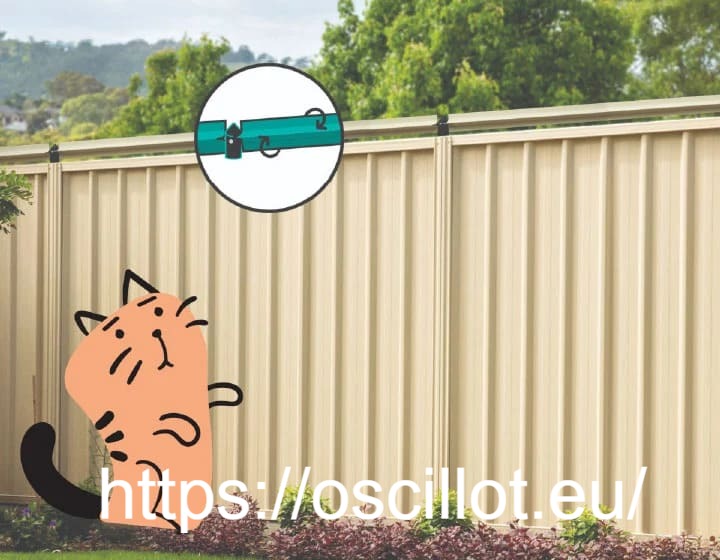
Rollers (rotating poles) on top of the fence
Rollers are best suited for wooden or PVC fences with vertical panels. A pole or tube must be attached horizontally to the top of the fence. Cats cannot climb over it because it rotates. This option is one of the most attractive, but also one of the most expensive. Why not make the rollers yourself? The idea seems simple, but in practice it is difficult to make rollers that rotate freely and easily when a cat touches them.

Transparent plastic film on both sides of the fence
Cats cannot climb on the film because it is slippery. The film must be of good quality to withstand cats’ claws and weather conditions ( bright sunlight, frost, and wind). It must be at least 50 cm long and attached to both sides of the fence to deter cats in the neighborhood. The transparent film is almost invisible and does not “spoil the view.” Its price varies considerably depending on quality, thickness, size, etc.

Net stretched between the fence and the house
A simple and fairly affordable solution for small or narrow gardens. However, the net must be strong enough to support the weight of a cat. One of the valuable advantages of this option is that birds cannot enter your garden to eat your favorite berries.

Electric fences and other options to avoid
An electric fence is not a good option for animals as small and fragile as cats. First of all, the electric shock can sometimes be much stronger than it should be (in rainy weather, for example). Second, the electrical voltage can drop unexpectedly or even stop for various reasons. The only way to monitor it is to measure it daily using a professional measuring device. Other options to avoid include barbed wire, metal bird spikes, electric collars, and so-called “vibration” collars for cats.

Attention!
Every hole in your garden must be sealed. The trunks of large trees must be surrounded by anti-cat “belts.” Think about other structures in your garden (greenhouse, small garden shed, etc.) located near the fence: your cat could climb on them and escape. In addition, ideally, cats should not have access to the parking area, in order to avoid accidents.

Advice: Make your cat-proof fence non-transparent
A non-transparent fence will help you to to avoid the following problems:
- Your neighbors have poisonous plants growing too close to your fence.
- Your neighbors like to spray pesticides in their garden.
- Dogs bark and run along the fence when they see your cat.
- Other cats try to interact with your cat through the fence.
- Your neighbor’s children dare to feed your cat. This can be fatal, especially if your cat is on a special diet (for diabetes or kidney failure, for example).